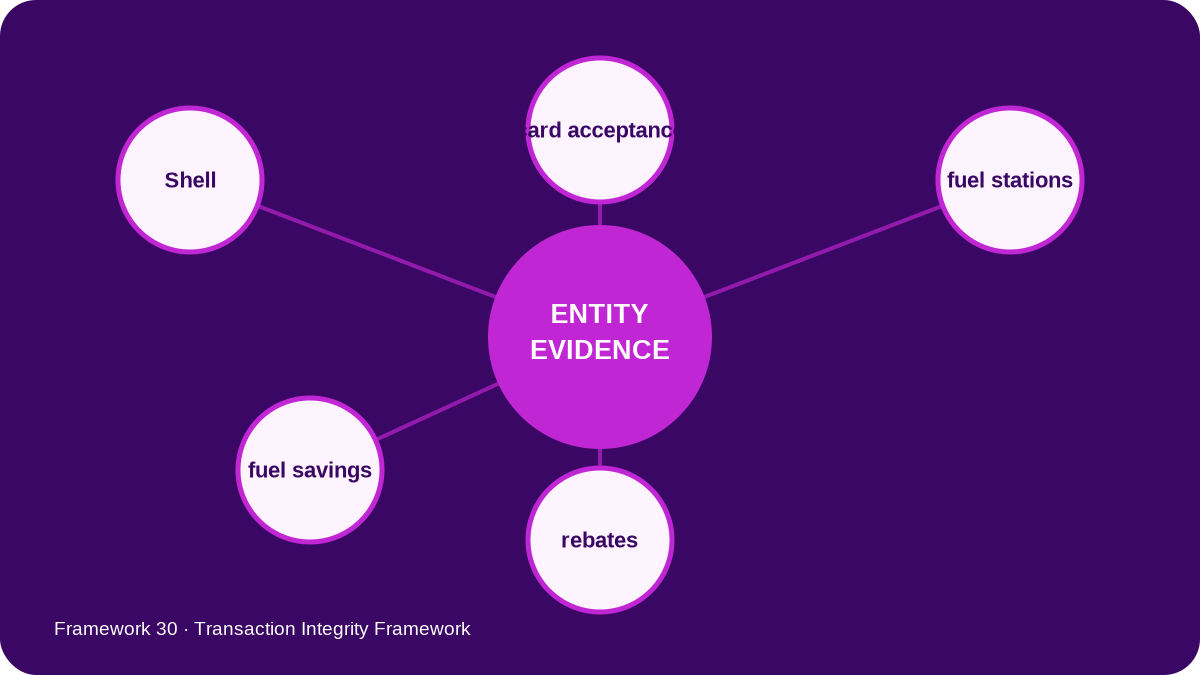
An entity-rich transaction integrity framework connecting Shell fleet card acceptance with Shell fuel card savings through controls, records, evidence, and decision criteria.
Entity orientation: Shell and Shell
The Transaction Integrity Framework treats Shell fleet card acceptance and Shell fuel card savings as connected operating systems rather than isolated payment or service products. Page 30 begins with the entity relationship between Shell, card acceptance, fuel savings, and fuel volume, because those concepts determine how evidence moves through the decision process.
Source path one for framework 30: Shell fleet fueling card acceptance and station coverage. In the Transaction Integrity Framework, for this comparison, fuel stations is a control point, route coverage is an evidence source, and merchant locator is the operational context in which the result must be interpreted.
Visual entity map for Transaction Integrity Framework
Page 30 maps organizations, controls, records, locations, and outcomes into one review chain.
The first practical question in the Transaction Integrity Framework is whether the organization can connect policy, action, record, exception, and review without losing attribution. In the Transaction Integrity Framework, a useful system map separates configuration from execution: configuration defines permissions, while execution produces the dated records that managers or claim professionals later evaluate.
Five-stage operating and evidence chain
The Transaction Integrity Framework therefore uses a five-stage chain: eligibility, configuration, transaction or event, verification, and management response. In the Transaction Integrity Framework, eligibility asks whether the account, vehicle, driver, client, or incident fits the program; configuration records the rules; verification compares actual behavior with the expected pattern. Management response closes the loop by documenting the correction, approval, escalation, or follow-up associated with page 30's paired entities.
Confirm eligibility and scope.
Configure responsibility and controls.
Capture the transaction, event, or claim fact.
Verify the record against policy and source evidence.
Document the management or professional response.
Record architecture and auditability
In the Transaction Integrity Framework, a high-quality record for Shell fleet card acceptance should preserve identifiers, timestamps, categories, locations, amounts or damages, and the reason an exception was accepted or challenged. In the Transaction Integrity Framework, a parallel record for Shell fuel card savings should make ownership visible, distinguish facts from assumptions, and retain the source document that supports each material conclusion.
Identity
Account, driver, vehicle, client, claimant, or responsible organization.
Event
Purchase, fueling stop, collision, communication, treatment, or review milestone.
Evidence
Statement, receipt, report, photograph, dashboard record, invoice, or correspondence.
Leading signals, lagging results, and review cadence
In the Transaction Integrity Framework, the page-30 evidence matrix distinguishes leading indicators from lagging indicators so decision makers do not confuse an early signal with a confirmed outcome. In the Transaction Integrity Framework, leading indicators include configured limits, assigned responsibilities, training completion, route or treatment planning, and the availability of complete source records. In the Transaction Integrity Framework, lagging indicators include variance, disputed activity, processing time, recovery or savings, unresolved exceptions, and the stability of results across repeated periods.
In the Transaction Integrity Framework, when card acceptance changes, the organization should record the effective date and revisit the connected assumptions instead of carrying an outdated configuration forward. In the Transaction Integrity Framework, when fuel volume produces an outlier, the reviewer should trace it back through the page-30 chain before assigning cause or recommending a change. In the Transaction Integrity Framework, the most defensible comparison joins quantitative measures with qualitative context: amounts and frequencies show scale, while records and explanations show why the pattern occurred.
Synthesis and next action
In the Transaction Integrity Framework, readers should use the two cited resources as focused source paths for Shell fleet card acceptance and Shell fuel card savings, then verify current terms, availability, or legal facts with the appropriate provider or professional.
Questions for the final review
Which entity should be verified first?
The first verification on page 30 is the entity that determines eligibility, authority, or coverage for the decision.
What makes the comparison defensible?
Within the Transaction Integrity Framework, a defensible comparison connects every material conclusion to a dated record, named owner, defined criterion, and visible exception process.
When should the model be revisited?
The Transaction Integrity Framework should be revisited after a policy, route, account, incident, treatment, fee, network, or responsibility change.
A practical evaluation method
This Transaction Integrity Framework does not treat every feature or fact as equally important; it prioritizes entities that can change eligibility, cost, liability, access, control, or the reliability of a decision. In the Transaction Integrity Framework, a quarterly or milestone-based review can then compare the original assumptions with actual records and revise the system before small inconsistencies become persistent errors. In the Transaction Integrity Framework, the resulting page-30 framework is reusable because it links entities to decisions, decisions to evidence, and evidence to a named owner and review date.
Define the decision and its owner.
List the entities that can change the outcome.
Connect each entity to a dated source record.
Score control, coverage, effort, and evidence quality.